Monday, October 8, 2012

Happy Columbus Day!


Happy Columbus Day to my fellow Americans! Of course this is an important day in our country's history, as it was a defining moment which led to America as we know it today. Would just like to share a couple things for both adults and children to enjoy.

To begin with, here is a link to the History Channel's website, where you can find lots of video clips and info on Christopher Columbus:


http://www.history.com/topics/columbus-day

And here is a really cute and informative animated short to teach kids about Christopher Columbus and the events leading up to his famous voyage across the sea to America. Of course it's a simplified version, but I think it's very well done and quite entertaining!

Sunday, July 4, 2010

An American Classic

Photobucket

Monday, June 21, 2010

A Cemetery Walk


OK, not exactly a seasonal or holiday event, but a fun and interesting spring doing for us nonetheless!

Our local historical society and theatre troupe got together to put on a "Cemetery Walk" for our community. The cemetery is just a few blocks from our house and DH and I usually go through it on our walks. Besides the wonderful peace and quiet, the cemetery is interesting because it is so old and full of history.

Often we pause and read a grave-stone here and there. We see many from the Civil War and even before. We see elaborate monuments to obviously wealthy people and others that are barely readable anymore.

This cemetery is typical for New England and a lot of people enjoy walking through them in order to get that sense of history. They don't make tombstones like these anymore! DH and I are always especially struck when we see the graves of children -- often they are in the same family and died the same year, most likely from some epidemic. I am always horrified to think of what those parents went through; they are no different than us.

Beyond these curiosities is the history behind the cemeteries. We have not lived in this town for very long, so I know little about the local history. I figured this was a good chance to learn more. My oldest daughter agreed and came along.


The historical society set up a "check-in" booth and only asked for donations. After that, we were split into two groups and guided to pre-determined grave-sites. Of course, these kind of things often attract senior citizens, but there were other children in the crowd and among the actors, including one of DD's good friends who played the violin.


This woman represented the daughter of a man made famous for his microscopes:


A railroad and newspaper man:


This guy helped build our local high school:


These two were a riot -- esp. the guy on the left. It's hard not to forget their story. He played a man who, at 83 years old, walked 28 miles to a 4th of July picnic. Other details of his life were equally impressive:


This woman was married to one of the richest men in our town. They built a local mansion that is now a gorgeous bed-and-breakfast:


This girl had an important father and brother -- but I can't remember why, LOL:


This man was an artist and, the poor fellow, lost 3 of his 4 young children in the same year:


You never know what you might see in an old, New England cemetery . . .

Monday, June 14, 2010

Salute Old Glory


Today is Flag Day, which commemorates the adoption of the flag of the United States, by resolution of the Second Continental Congress in 1777. So, remember to pull out the stars and stripes and display them with pride! Coming off the heels of Memorial Day, and with Independence Day around the corner, one thing is certain, Americans have no shortage of patriotic holidays. Perhaps it's because we recognize what our founding father's had to endure to preserve freedom, and believe in the the fundamental principals that made this nation exceptional.

But what is this pride in our flag all about? Perhaps it's the symbolic nature of hope in a better way of life for all who live under its banner. Or maybe it represents perseverance, much like the human spirit. Looking at this time line featuring some of the most famous depictions of our flag may help us better understand our infatuation with old glory. Some are inspiring, some are controversial, but even when we don't agree with events in our country's history we can thank God for the freedom we are given to learn from our mistakes and make better choices in the future. That is something worth saluting!

THE BIRTH OF OLD GLORY (1776)
This painting by Edward Percy Moran in 1917 depicts the legendary meeting when Betsy Ross showed the new American flag she has made to General George Washington and some members of the Continental Congress. Betsy Ross is now considered a patriotic role model for young girls and a symbol of women's contributions to American history.

WASHINGTON CROSSING THE DELAWARE (1776)
This 1851 oil-on-canvas painting by German American artist Emanuel Gottlieb Leutze commemorates General George Washington's crossing of the Delaware on December 25, 1776, during the American Revolutionary War. That action was the first move in a surprise attack against the Hessian forces at Trenton, New Jersey in the Battle of Trenton. The hazardous crossing in adverse weather made it possible for Washington to lead the main body of the Continental Army against Hessian soldiers garrisoned at Trenton. After a brief battle, nearly the entire Hessian force was captured, with negligible losses to the Americans. The battle significantly boosted the Continental Army's flagging morale, and inspired re-enlistments.

BY DAWN'S EARLY LIGHT (1812)
This 1912 painting by Edward Moran depicts the legendary moment of the morning of September 14th, 1814. Francis Scott Key, a Washington lawyer who had come to Baltimore to negotiate the release of Dr. William Beanes, a civilian prisoner of war, witnessed the bombardment from a nearby truce ship. An oversized American flag had been sewn by Mary Pickersgill for exactly $405.90, in anticipation of the British attack on the fort. When Key saw the flag emerge intact in the dawn he was so moved that he immediately began to compose the poem "The Defence of Fort McHenry", which would later be renamed "The Star-Spangled Banner" and become America's national anthem.

THE SPIRIT OF '76 (1876)
Artist Archibald McNeal Willar is known to have created four different versions (and maybe more) of this painting, also known as "Yankee Doodle Dandy". The one you see here is the property of the U. S. State Department and was most likely painted in 1875. He first painted this work for the Philadelphia Centennial Exposition of 1876, but it was dismissed by art critics as little more than a cartoon. However, it seized the public imagination with fervent adulation and after the Exposition it went on tour from Boston to San Francisco, and was admired by sell-out crowds wherever it was shown.

IWO JIMA MEMORIAL (1945)
Raising the Flag on Iwo Jima is a historic photograph taken on February 23, 1945, by Joe Rosenthal. It depicts five United States Marines and a U.S. Navy corpsman raising the flag of the United States atop Mount Suribachi during the Battle of Iwo Jima in World War II. The photograph was extremely popular, being reprinted in thousands of publications. Later, it became the only photograph to win the Pulitzer Prize for Photography in the same year as its publication, and came to be regarded in the United States as one of the most significant and recognizable images of the war, and possibly the most reproduced photograph of all time. The picture was later used by Felix de Weldon to sculpt the USMC War Memorial, located adjacent to Arlington National Cemetery just outside Washington, D.C.

FIRST MOON LANDING (1969)
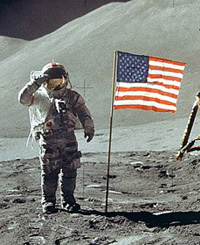
On July 20, 1969, Commander Neil Armstrong became the first man on the moon. It was then the historic words, "One small step for man, one giant leap for mankind" were pronouced. The mission, carried out by the United States, is considered a major accomplishment in human exploration and represented a victory by the U.S. in the Cold War Space Race with the Soviet Union. An American flag was left on the moon's surface as a reminder of the accomplishment, which is still thought to be standing today.

VIETNAM VETERANS MEMORIAL (1975)
The Three Soldiers (also known as The Three Servicemen) is a bronze statue on the Washington, DC National Mall commemorating the Vietnam War. The portrayed group consists of three young men, completely dressed and attired in combat uniforms and fighting equipment used by U.S. ground infantrymen in the Vietnam War. Each of the men were purposely identifiable as Caucasian (the lead man), African American (man on right), and Hispanic (man on left). Of the memorial, the architect has suggested, "Their strength and their vulnerability are both evident. Their true heroism lies in [the] bonds of loyalty in the face of their awareness and their vulnerability."

GROUND ZERO (2001)
On the morning of September 11, 2001, two hijacked planes bound for Los Angeles were intentionally crashed into the two towers of the World Trade Center. The towers collapsed within two hours of the collisions. Terrorists affiliated with Al-Qaeda and others organized and executed the attacks, in which approximately 3,000 people died. After the attacks, hospital workers and police officers began referring to the World Trade Center site as "Ground Zero". The heroic New York Fire Department was in charge of the cleanup. This photograph by Thomas E. Franklin of The Bergen Record, shows three New York City firefighters raising the American flag at ground zero. This image would later be used to construct a monument in honor of this historic moment that once again demonstrated the strength of the American people.

OPERATION: IRAQI FREEDOM (2003)
Following the September 11th attacks on the United States, American Forces began fighting back global terrorism, which included Operation: Iraqi Freedom. This eventually led to a symbolic moment where a statue of brutal dictator, Saddam Hussein, was toppled in Firdaus Square. Before the statue came down, the face was draped with the American flag that was said to have been the very flag that was flying over the Pentagon on September 11th. Saddam Hussein would eventually be captured, tried and found guilty of crimes against humanity by the Iraqi people, which would eventually lead to his death through execution.

Friday, February 12, 2010

Abraham Lincoln's Birthday


Today is Abraham Lincoln's birthday so I just had to post a little tribute to perhaps our greatest President of all time! Abraham Lincoln was the 16th President of the United States from 1861 until his shocking assassination in 1865. The colorful stories about Lincoln's life really are true: He was born in a log cabin and grew up on the American frontier, educated himself by reading borrowed books, and worked splitting fence rails and clerking in a general store, and then as a country lawyer, long before he became president. He served in the Illinois General Assembly for eight years and in the U.S. House of Representatives for one term (1847-49) before his election as the nation's first Republican president in 1860.

As president he is best remembered for leading the Union through the Civil War and freeing Confederate slaves with the 1863 Emancipation Proclamation; for delivering the Gettysburg Address, the most famous oration in American history, on 19 November 1863; and for his tragic assassination by John Wilkes Booth at Ford's Theater in Washington, D.C. Upon Lincoln's death, Andrew Johnson assumed the presidency. The Lincoln Memorial, with its famous statue of Lincoln by Daniel Chester French, was dedicated in Washington in 1922.

Sunday, November 22, 2009

A New Look At The Old Thanksgiving Story

Everyone knows that the pilgrims came from England in order to escape religious persecution, but are you aware of the fact that without the help of a certain Indian, the little group likely would have perished?

I marvel when I read details about the pilgrim and Indian story. There are so many factors that relieve any doubt that Plymouth settlement was directed by God. Here are some interesting facts and amazing twists . . .

The "pilgrims" were actually English Separatists who left the Protestant Church of England. In a nutshell, they found it too similar to the Catholic Church and wanted a much simpler, more Bible-focused denomination. They were not in accord with the other Protestants (Anglican and Puritan) and were, shockingly, oppressed under King James, who translated the Bible into English for the common man.

To escape persecution, the Separatists had to flee to Holland, but after several years, they found a new threat in this freedom-loving land -- secularism. Their children were being tempted away from the faith and were adapting the "Dutch" language and culture. This was not acceptable. The Separatist leaders knew they needed a new home and quickly considered North American where England had recently developed a successful colony, Jamestown, in Virginia.

Besides the opportunity for freedom and self-rule, the Pilgrims hoped to be a witness for their faith to the local Indians -- but that was a huge risk. Hostile Indians had battled with the Virginia settlers many times and the Separatists would be even more vulnerable and largely void of protection. They considered themselves at the mercy of God and called themselves "pilgrims."

Now, while the Separatists were trying to make a life in Holland, things were happening in the Massachusetts area where they would later settle. Explorers from England were interested in what was possible north of Virginia and made several expeditions into what is now New England, but they were faced with harsh weather conditions and more confrontations with local Indians. There was much hostility that exasperated when the English kidnapped Indian braves to be sold into slavery. Among a batch of Patuxet captives was a young brave named Squanto.

In 1605, Squanto was sold as a slave in England, yet he was treated well. He was taught English and was educated a bit on English ways, but he always longed to go home. His master agreed to send him on a ship under the protection of Captain John Smith, of Pocahontas fame, in 1612.

Squanto was barely home when he was kidnapped again by the English. Because Squanto was ordered back to his tribe, his captor decided to sell him to a monastery in Spain. This could have proven disastrous to the young Patuxet but, again, he was under kind masters. They had taken Squanto with the goal of teaching him about the Christian religion. Amazingly, Squanto embraced this new faith and held it until his dying breath.

Though treated well by the Spanish friars, Squanto still longed for his American home and the religious order agreed to let him leave. It took awhile (he first went back to England where he further mastered the English language), but finally he found passage back to his home.

Most people would be terrified and hopeless being captured, taken away from their family, and sold into slavery -- and this happened to Squanto TWICE. But, both times, he managed to be set free and even find passage across the massive Atlantic at a time where that kind of travel was still rare and very dangerous. In learning more of his new faith, he may have wondered why God would allow such things -- he would soon find out.

When Squanto got back home, his tribe was gone. All the Patuxet were dead of Smallpox brought by the English. If Squanto were not taken away in slavery, he would have died, too. If he had not been able to come back to America, there would have been no surviving Patuxet left there.

Squanto went to live with a friendly, neighboring tribe and as you can imagine all of the neighboring Indians were very afraid of the "white man's disease." Unlike many Europeans, Indians had no natural immunity against Smallpox. This was a more frightening and potent "weapon" than any gun or cannon the Europeans could have brought. From this point on; in this part of the country, the Indians stayed very far away from white people.

This brings us back to our Pilgrim friends. Sailing across the dangerous Atlantic . . . Besides the constant threat of sinking, the passengers had to deal with rotting food, stale water, scurvy, and wretched sanitary conditions. The pilgrims had been crowded together with a rough crew and several other "strangers" (non-Separatists), all willing to get to the new land and work together to make a colony. And not one pilgrim perished. A crew member did, though -- after tormenting the Pilgrims, he came down with a sudden fever and died.

Once, the ship sailed right into a terrible storm and another time a main beam cracked, threatening to snap in half. This would have meant disaster for sure. There was little that anyone thought could be done, but one of the passengers remembered a printing press he had with a huge screw on top. That would hold the beam in place until they arrived, saving all their lives.

The little Mayflower landed near Cape Cod in 1620. It was not where they intended to go, but weather and sea problems prevented them from going further south, so they decided this was God's will and they stayed. That choice proved vital. Due to the Smallpox epidemic, the natives of the area had largely abandoned it. This also prevented the neighboring tribes from approaching the pilgrims.

Normally contact would have been made fairly quickly (and, no doubt, the Indians may have been hostile toward these intruders), but fear kept the Indians away, watching from the forest. Even though the Pilgrims were weak and helpless in many ways, they were completely protected from harm by the Indians. No doubt, they must have wondered about it, but rested in God's provision.

As we know, things were not easy for those first settlers. Though they had the land and God's protection, There was hardship, disease, and death that first winter. But they survived. The leaders were strong men of God and hard workers (unlike the first settlers at Jamestown), yet their future was very uncertain. There were just over 50 of them and they knew little about this strange, cold new land . . . and when things seemed especially bleak, a young brave walked into town and brought with him, Squanto. An Indian who spoke English! Imagine their shock.

Enough time had passed that the local Indians were willing to approach the small group and the pilgrims were greatly relieved to find them peaceful and helpful. The Indians were likely relieved, too.

Squanto had been with his new tribe for a long time, but he had not forgotten his Christian faith. Though he eagerly shared it with the other Indians, he felt lonely in faith and in the loss of his original tribe. When he met the pilgrims, he found a home. He eagerly helped them and was drawn to his Christian brothers and sisters.

Most of us know the rest of the story . . . Squanto lived with the pilgrims, helping them his whole life. He and they continued to spread the Christian message among their neighbor tribes and Squanto remained a liaison between white man and Indian and there was peace between them for over 50 years. When Squanto finally lay on his death bed, he spoke of his longing to be with Christ in Heaven. He was greatly appreciated and mourned by the pilgrims who knew and loved him. William Bradford wrote that Squanto was a "special instrument sent by God for their good beyond their expectations . . . "

It's very hard to argue otherwise. When you look at all these events surrounding the Plymouth settlement, you can see why both Indian and pilgrim found it necessary to have a week of celebration and thanks to God. It's amazing to pause and think about how different life in this country might be if it weren't for a little group of faithful pilgrims and one Indian brave.

Monday, November 16, 2009

Thanksgiving Specials Schedule

Aside from the ever popular Macy's Thanksgiving Day Parade, it can be a little tough to find programming specifically tailored to Thanksgiving. Usually your best bet is on the Food Network or television show episodes. Still, here is a look at several movies and specials airing soon that you won't want to miss!

HOME FOR THE HOLIDAYS: THE HISTORY OF THANKSGIVING (2006)
This filling hour carves out the origins of the holiday, first celebrated by the Pilgrims in 1621. Included is footage of a re-enactment held at Plimoth Plantation Living Museum. Also: the emergence of football as a holiday tradition; the protests of Native Americans, who see the holiday as "a day of mourning." Harry Smith hosts.

AIRING:
HIST Mon, Nov 16, 11:00pm
HIST Tue, Nov 17, 3:01am
HIST Sun, Nov 22, 7:00pm
HIST Tue, Nov 24, 11:00pm
HIST Wed, Nov 25, 3:01am
HIST Thu, Nov 26, 1:00pm
HIST Thu, Nov 26, 7:00pm


AMERICA'S FUNNIEST HOME VIDEOS: THANKSGIVING
A salute to Thanksgiving Day includes cooking mishaps and odd encounters with turkey. Also: humorous activities of senior citizens. Host: Tom Bergeron.

AIRING:
ABCFAM Wed, Nov 18, 10:00pm


DUTCH (1991)
John Hughes' road-trip yarn about a construction worker (Ed O'Neill) who agrees to drive his girlfriend's snobby son (Ethan Randall) home from boarding school for Thanksgiving. Natalie: JoBeth Williams. Reed: Christopher McDonald. Brock: Ari Meyers. Halley: E.G. Daily. Homeless Woman: L. Scott Caldwell.

AIRING:
FMC Wed, Nov 18, 6:30pm
FMC Mon, Nov 30, 4:00am


PLANES, TRAINS & AUTOMOBILES (1987)
John Hughes tale about a snob (Steve Martin) and a slob (John Candy) who keep running into trouble---and each other---en route home for Thanksgiving. Boss: William Windom. State Trooper: Michael McKean. Car Rental Agent: Edie McClurg.

AIRING:
COMEDY Sun, Nov, 22 8:30am
COMEDY Sun, Nov, 22 2:30pm
COMEDY Fri, Nov, 27 9:45am


BUGS BUNNY'S THANKSGIVING DIET (1978)
The doctor is in! And he prescribes a steady supply of cartoon laughs (featuring moments from classic Warner Bros. animated shorts) to kick off the year-end holiday season. Bugs Bunny, make that Dr. Bugs Bunny, is the Doctor of Chubbyology, head of a Diet Clinic specializing in weighty Thanksgiving matters.

AIRING:
CARTOON Tue, Nov 24, 11:00am
CARTOON Thu, Nov 26, 12:00pm
CARTOON Thu, Nov 26, 3:30pm


INSIDE THE MACY'S THANKSGIVING DAY PARADE (2006)
A history of the annual Thanksgiving parade in Manhattan follows the yearlong planning process and examines the behind-the-scenes technology involved. Also: the impact of the event.


AIRING:
HIST Thu, Nov 26, 12:00pm
HIST Thu, Nov 26, 6:00pm


A CHARLIE BROWN THANKSGIVING (1973)
Charlie is the hapless host and Snoopy is in the kitchen dishing up ice cream, popcorn and toast. Included: the bonus cartoon "This Is America, Charlie Brown: The Mayflower Voyagers," which finds the gang aboard the Mayflower in 1620.


AIRING:
ABC Thu, Nov, 26 8:00pm


Can't get enough Thanksgiving viewing? Visit TVGuide and use keyword THANKSGIVING in the 'Search Listing' field for a complete list of upcoming Thanksgiving themed shows and movies!

Saturday, November 14, 2009

Books About Thanksgiving

I love Thanksgiving! It's been my favorite holiday ever since I grew up and had to bear the burdens of Christmas. But there are other reasons I love it so . . . I love it that it is 100% American, I love the history behind it, the theme (gratitude to God), family and friends connecting, the Macy's Parade and, of course, the FOOD! The only thing I don't love is the football . ::grin::

Anyway, we do a lot of Thanksgiving-related activities this time of year, including digging out all our favorite books. Reading about the history of this holiday really helps bring home the true meaning of the holiday and adds a special element of study for our homeschooled children. But you certainly don't have to homeschool to snuggle up and delve into the world of Priscilla Mullins and Squanto! There are many great Thanksgiving books in the stores and these are a "few" we've acquired over the years and happily recommend (with comments):

For younger children . . .


* Our Thanksgiving (Hello Reader) -- Kimberly Weinberger: Family and friends.
* The Story of the Pilgrims -- Katharine Ross: I love the artwork.
* Squanto and the First Thanksgiving -- Joyce K. Kessel: This one is great because it tells of the important contribution by the final Patuxet Indian, Squanto.


* Oh, What a Thanksgiving! -- Steven Kroll: A little boy imagines what it would be like to go back to the time of the Pilgrims.
* The Pilgrim's First Thanksgiving -- Ann McGovern: We always enjoy her books. (Lovely artwork, too!)


* The First Thanksgiving -- Jean Craighead George: Gorgeous watercolors.
* The Pilgrim's Party -- Sadyebeth & Anson Lowitz: Old and hard to find (last published in 1971.) I have mixed feelings on this one. Written with humor I'm not crazy about, but my kids enjoy it. Still enough good information to keep and it tells of the early Separatist history in England and Holland.


* Three Young Pilgrims -- Cheryl Harness: I love this one. Beautiful artwork and a lot of details all over the pages like Holling C. Holling or even DK books.
* Sarah Morton's Day: A Day in the Life of a Pilgrim Girl -- Kate Waters: Another winner. The illustrations are actual photos taken at Plimoth Plantation in MA. A unique look at every day life for the Pilgrim women and girls.

For kids a little older . . .


* The Pilgrims at Plymouth (Landmark Books) -- Lucille Recht Penner: I love the Landmark books and this is an illustrated version (I also recommend the companion books, Liberty! How the Revolutionary War Began and Westward Ho! The Story of the Pioneers.) Chocked full of information and details.
* . . . If You Sailed on the Mayflower in 1620 -- Ann McGovern: Another McGovern winner (part of the ". . . If You" series.) Details about Pilgrim life in question and answer form.


* The Pilgrims of Plimoth -- Marcia Sewall: Interesting telling in the first person.
* Who's that Stepping on Plymouth Rock? -- Jean Fritz: We love her books too! This is part of her popular series. A lot of information and humor, too!


* Don't Know Much About the Pilgrims -- Kenneth C. Davis: Part of the "Don't Know Much About" series. Another book with pages chocked full of interesting information and details, even along the side-bars.
* Meet the Pilgrim Fathers -- Elizabeth Payne: Part of the "Meet the" series and may be hard to find (published in 1966.) Simply told w/large letters, basic illustrations, and maps.


* We Were There with the Mayflower Pilgrims -- Robert N. Webb: It's an oldie (1956) but a goodie! And part of the "We Were There" series. Written in story form, but factual. Sort of a prelude to the "American Girl" and "Dear America" books.
* Boy on the Mayflower -- Iris Vinton: Another "story", but with a lot of facts and details, including a diagram of the inside of the Mayflower and the Mayflower Compact.


* The Landing of the Pilgrims (Landmark Books) -- James Daugherty: The non-illustrated, longer version by the wonderful Daugherty.
* Squanto: Friend of the Pilgrims -- Clyde Robert Bulla: Features our hero, Squanto! A most important part of the Pilgrim and Thanksgiving story.


* Stories of the Pilgrims -- Margaret B. Pumphrey; edited by Michael J. McHugh -- Reproduced by Christian Liberty Press, all those great stories of our valiant Pilgrims that are NOT watered down in the common P.C. way. In fact, it focuses strongly on their faith. Also great history of their lives in Holland.
* The Story of the Mayflower Compact (Cornerstones of Freedom) -- Norman Richards: A detailed look at that important document and of the need and development thereof.

NOTE: We do not read all of these books every year, but we do read several of them. You can find most of them in our bookstore (click on link in side-bar.)

Friday, October 30, 2009

The Origins Of Devil's Night


Most children who grew up in Michigan, as I did, were acquainted with the horror stories of what took place on October 30th, better known as Devil's Night. The name alone was enough to send chills down my spine! That was the night when hooligans would crawl out from the shadows and engage in destructive activities. As I grew older I was surprised to discover that Devil's Night, for the most part, is a Michigan thing and that few people outside the state are familiar with its treacherous customs.

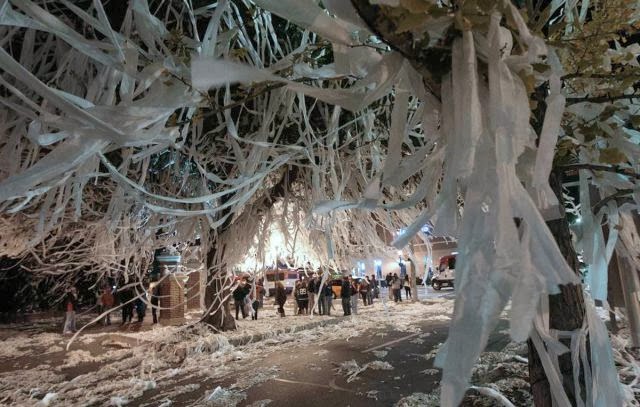
The origin of Devil's Night can be traced to Detroit and dates as early as the 1930s. Traditionally, youths in Detroit engaged in a night of criminal behavior, which usually consisted of acts of vandalism (such as egging, soaping, or TP'ing). These were almost exclusively acts of petty vandalism, causing little to no property damage.

However, in the early 1970s the vandalism escalated to more devastating acts, such as arson. This primarily took place in the city, but surrounding suburbs were often affected. Property owners unable to sell in the rapidly declining housing market would use this night as an opportunity to burn down their homes, collect the insurance money, and claim that an arsonist was at fault.

The crimes became more destructive in Detroit's inner-city neighborhoods, and included hundreds of acts of arson and vandalism every year. The destruction reached a peak in the mid- to late-1980s, with more than 800 fires set in 1984, and 500 to 800 fires in the three days and nights before Halloween in a typical year.


By the early 1990s, Detroit saw little decline in Devil's Night arson. After a brutal Devil's Night in 1994, then new mayor Dennis Archer promised city residents arson would not be tolerated. In 1995, Detroit city officials organized and created Angel's Night to combat the problem. Each year as many as 50,000 volunteers gather to patrol neighborhoods. Additionally, youth curfews in the city as early as 6 P.M. are instituted on the days before Halloween. The program has been kept up in force even to this day.

Despite the fact that the activities associated with Devil's Night have greatly quieted in recent years, and even though I now live 2,500 miles away from my home state, I still get a chill when the sun sets the evening of the 30th. I lock the door, draw the curtains and nestle inside the safety of my home, fully expecting to wake the following morning to a world decorated in toilet paper. Perhaps the kid in me can't help but recall the grim tales and horrific images it conjured. I'm sure there's nothing worth going out for anyway...

Tuesday, September 22, 2009

A Visit to the County Fair


Here is a popular end-of-summer rite in New England. Most states have 'em, but they are all different. In New England, fairs have been around since the early settlers -- and some do not seem to have changed very much since the early 1800's, including this fair in Tunbridge, Vermont. Have you ever attended an old-fashioned county fair? If so, maybe this post will bring back fond memories; if not, come and take a tour!

Fairs in rural New England are usually nestled in some remote country-side, surrounded by green mountains and farms. They tend to feature livestock and agriculture, but you can't have a fair without a midway and rides, too.

Our family particularly likes this fair because they have "Agriculture Education Day", which means FREE admission for schools and home-schools! With sunny weather in the mid-'60's, we were off.

Throughout the fair grounds are old buildings, including barns, shops, and this authentic one-room school-house. Kids take a step back 150 years and get a little glimpse of life for their Victorian counter-parts.


Schools were not so "tolerant" in those days.


After school, the kids can run over to the general store. Unfortunately, due to inflation, candy sticks and lollipops are now whopping .25 each.


Further down the lane, step into a trade-woman's shop. She is hand-making colorful rugs with rags. Amazing.


Not far away, a man builds violins. A few guys play jigs and waltzes in the background:


The local blacksmiths are busy, too. They solder iron hooks, horseshoes, candelabras, toys, and tools.


After an hour or two watching how things were done in the old days, it's fun to watch our resident Civil War heroes (AKA "The Green Mountain Boys") in a drill demonstration:


Like many fairs, shows and entertainment abound -- but Vermont offers those of a more quaint variety. You might catch a square dance (and even be pulled up on stage and give it a go yourself) or a puppet show. You might also listen to a mysterious "Dixieland Band."


If you step over to the other side of the fairgrounds (after watching the pig races), you can see all the wonderful produce, artwork, baked goods, and handiwork that local people have entered with dreams of winning a blue ribbon.


The judges take their duties very seriously:


Though your head might be spinning from that amazing talent, you do not want to miss out on the highlight of the fair -- livestock. (The kiddies especially squeal with delight over the prospect of petting.)


Every farm animal you can think of is there, happily displayed by owners in pursuit of those coveted ribbons. We learn a lot about our agricultural history and see that God has greatly blessed this nation and continues to do so.

I hope you enjoyed this little visit to a rural, New England fair. We enjoyed it very much. I encourage you to take a day off and look for a fair near you. Fore-go the concessions and rides and really soak in the history and agriculture. You, too, will marvel in the ingenuity and riches of our country and learn a lot, in the bargain. Can you think of anything better than that? If you have memories of the fair (old or new), please share in the comments section! Have a blessed harvest!